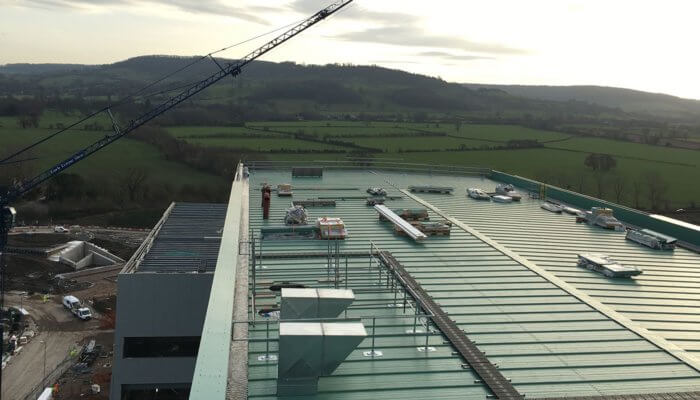
Weatherproofing for service penetrations can often be addressed late in a project, after roof coverings and wall finishes have been installed, building services are in place and access has become more restricted.
At this stage, weatherproofing penetrations can be more challenging. Other building elements may be in the way, scaffolding may have been removed and rainwater may have already begun to seep into the structure and cause damage.
Early engagement with weatherproofing specialists such as the Jones Weatherproofing team can help ensure service penetrations such as vertical penetrations are protected in the right way and at the right stage of a project. This can reduce the risk of remedial works, avoid unnecessary disruption and ensure weatherproofing is integrated effectively with the overall building design and requirements.
But what factors should specifiers and architects think about when planning weatherproofing for services within roof penetrations? In this blog, we will look at some of the considerations that can help ensure durable, effective weather protection for the building fabric and the building’s contents and occupants.
Type: What kind of service penetration weatherproofing is right for the project?
Various methods can be used to weatherproof a service riser. Traditional dog-kennel-style enclosures have been used for many years and may provide a suitable option in some situations. However, they also have limitations, as they tend to take up a lot of space and, being fixed structures, they don’t offer flexibility if services need to be modified at a later stage.
Matthew Jones, commercial director at Jones Weatherproofing, explains that liquid-applied weatherproofing allows service penetrations to be weatherproofed directly around the services. “This minimises space requirements and also allows greater flexibility during installation and future modifications. The result is a joint-free weatherproofing layer that is both durable and adaptable,” he says.
Placement: Where should a service penetration be located?
The right location for a service penetration will depend on factors such as the amount of available space, roof geometry and the positions of other building elements. Ideally, the placement of penetrations should be considered early in the design process, before the roof or wall build-up is finalised. This will help ensure that the penetration can be installed correctly and weatherproofed effectively.
“Plans can, and do, change during construction,” Matthew notes. “Penetrations move or their sizes change as the project progresses. Because of this, the weatherproofing system needs to be flexible enough to accommodate changes to penetration size and placement,” he says.
When positioning a service penetration, check the following:
- Keep penetrations away from roof edges or junctions, as this can make weatherproofing more complex.
- Ensure sufficient space around each penetration, allowing room for weatherproofing, maintenance and inspection.
- Consider the proximity of other penetrations and roof installations, as positioning them too close together may restrict access or complicate the weatherproofing process.
- Check roof falls and drainage to ensure water cannot collect around the penetration.
Access: How will the weatherproofing team access the service penetration?
The weatherproofing team will need safe and practical access to the service penetration. This is often easiest before other building elements, such as plant or walkways on roofs, are installed. On walls, it is generally preferable to complete the weatherproofing before cladding or other finishes are installed.
“Where scaffolding, platforms or lifting equipment are required for access, it makes sense to schedule the weatherproofing works while these are already on site,” Matthew explains. “Doing so can help avoid unnecessary delays and costs, as well as the need to bring access equipment back to site later in the project,” he adds.
Programming: When is the best time to carry out weatherproofing?
Weatherproofing should be installed as early as possible after the penetrations have been installed and before access becomes restricted. The exact timing will depend on project requirements, but coordinating the work with other trades will help improve accessibility, reduce the risk of delays and avoid the need to remove completed building elements to access the penetration.
Structural integrity: How can service penetration weatherproofing maintain building performance?
The primary role of service penetration weatherproofing is to prevent the impact of weather, protecting the building from rot, mould and mildew, which can lead to structural deterioration.
“The weatherproofing system should therefore provide a durable seal that protects the building structure, and it should be installed before things like rainwater can get into the structure,” explains Matthew. “It should also be flexible enough to accommodate normal building movement caused by thermal changes, loading and settlement without cracking or compromising the watertight barrier,” he adds.
Future access: Will the service penetration require maintenance, modification or inspection?
Over the life of the building, service penetrations may require maintenance, modification or inspection. Careful planning can help ensure that future access is possible without having to remove other elements or bring in access equipment unnecessarily.


Durability: How long will the service penetration weatherproofing last?
Long-term protection against water ingress is the goal, and a good system needs to withstand exposure to weather, UV radiation and normal building movement over many years. The right weatherproofing system can reduce maintenance requirements and lower the likelihood of remedial works over the life of the building.
“Jones Weatherproofing’s cold-applied liquid weatherproofing system is backed by a 25-year system warranty,” Matthew notes.
Compatibility: Is the service penetration weatherproofing suitable for the roof or wall build-up?
The weatherproofing system should be compatible with the surrounding roof or wall construction, including membranes, roof coverings, cladding systems and insulation materials. A system that can be used across multiple substrates helps simplify specification and ensures a consistent weatherproofing approach where different construction materials meet.
“At Jones Weatherproofing, our liquid weatherproofing resin is cold-applied and solvent-free. This makes it suitable for all roof types, including GRP roofs. It requires no heat for application or curing and hardens in less than an hour,” Matthew adds.
Aesthetics: Does the service penetration weatherproofing complement the design intent?
Good weatherproofing protects the building without detracting from its appearance. Bulky enclosures such as those in off-the-shelf systems can interrupt the visual lines of a building, while colour schemes should also be preserved wherever possible. Liquid-applied weatherproofing sits flush with the roof surface for a clean and discreet finish, and it can be colour-matched to the roof covering to help maintain the design intent and match any branding requirements.
Fire performance: Does the roof penetration support compliance with fire safety standards?
Fire safety is a critical consideration for all buildings. Approved Document B (England) states that for a roof system to be considered ‘unrestricted’ in use, it must achieve the BROOF(t4) classification. Similar requirements exist in Scotland, Wales and Northern Ireland.
BROOF(t4) classification applies to complete roof assemblies rather than individual products. This means that the fire performance of penetration weatherproofing must be considered as part of the wider roof system, including the substrate, insulation and other components.
Jones Weatherproofing systems have been tested as part of complete roof assemblies that have achieved BROOF(t4) classification in accordance with BS EN 13501-5:2016. These test results demonstrate that Jones Weatherproofing systems can form part of roof assemblies achieving BROOF(t4) classification when installed as part of a tested configuration.
Bespoke solutions: What are the benefits of a tailored service penetration weatherproofing approach?
At Jones Weatherproofing, we offer bespoke weatherproofing using a cold-applied liquid suitable for use with any type of cladding or building system. The result is a joint-free installation that prevents leaks and thermal breaks while contributing to the thermal performance of the building. We also provide comprehensive technical support and project planning, helping to ensure that weatherproofing is carried out effectively and at the right time to meet the project requirements.
Get in touch to discuss how we can support the weatherproofing requirements of your upcoming projects.