Common service riser FAQs

Share page here

Service risers are a common feature in modern buildings, carrying electrical, mechanical and communications services from one level to another, or through the roof.

Jones Weatherproofing offers a liquid-applied system for weatherproofing service risers and other types of building penetrations. It is suitable for all kinds of roof build-up and allows services to run vertically without compromising watertightness. It also simplifies access and can be easily adapted as service requirements or layouts change.

Below are the answers to frequently asked questions about our service riser weatherproofing.

Are there any types of penetrations that can’t be used with riser systems?

Question: Are there any types of penetrations that can’t be used with riser systems?
Answer: No. The Jones Weatherproofing system provides effective weatherproofing for all standard service riser penetrations. It can be used to weatherproof around cable trays, HVAC ductwork, exhaust vents, water pipes, gas pipes, electrical supplies and mechanical services. It also offers complete design flexibility and can be adjusted to suit any roof layout.

Can different services be run through the same building penetration?

Question: Can different service types be run through the same penetration?
Answer: Yes. With the Jones Weatherproofing system, different service types can be run through the same penetration. For example, electrical and mechanical services can run together, as long as the requirements for separation, fire stopping, thermal performance, safety and other compliance considerations are met.

Are service risers more prone to water ingress due to ponding or other flat-roof phenomena?

Question: Are service risers more prone to water ingress due to ponding or other flat-roof phenomena?
Answer: No. When correctly detailed, service risers should not be prone to water ingress due to ponding or any other flat-roof phenomena.
The Jones Weatherproofing system provides effective rainwater management for flat and pitched roofs. Where appropriate, falls can be incorporated into the build-up, helping rainwater drain away from the penetration more quickly. The liquid-applied system also creates a continuous layer with no seams or joints where water could collect or penetrate.
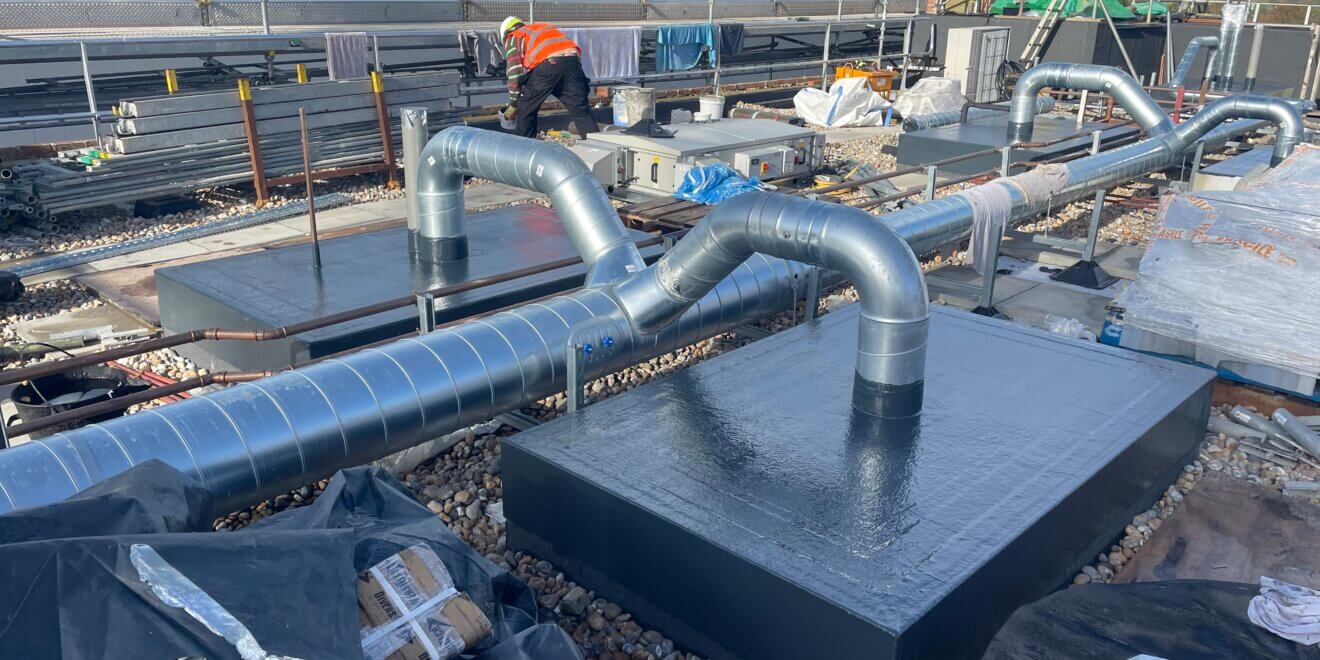
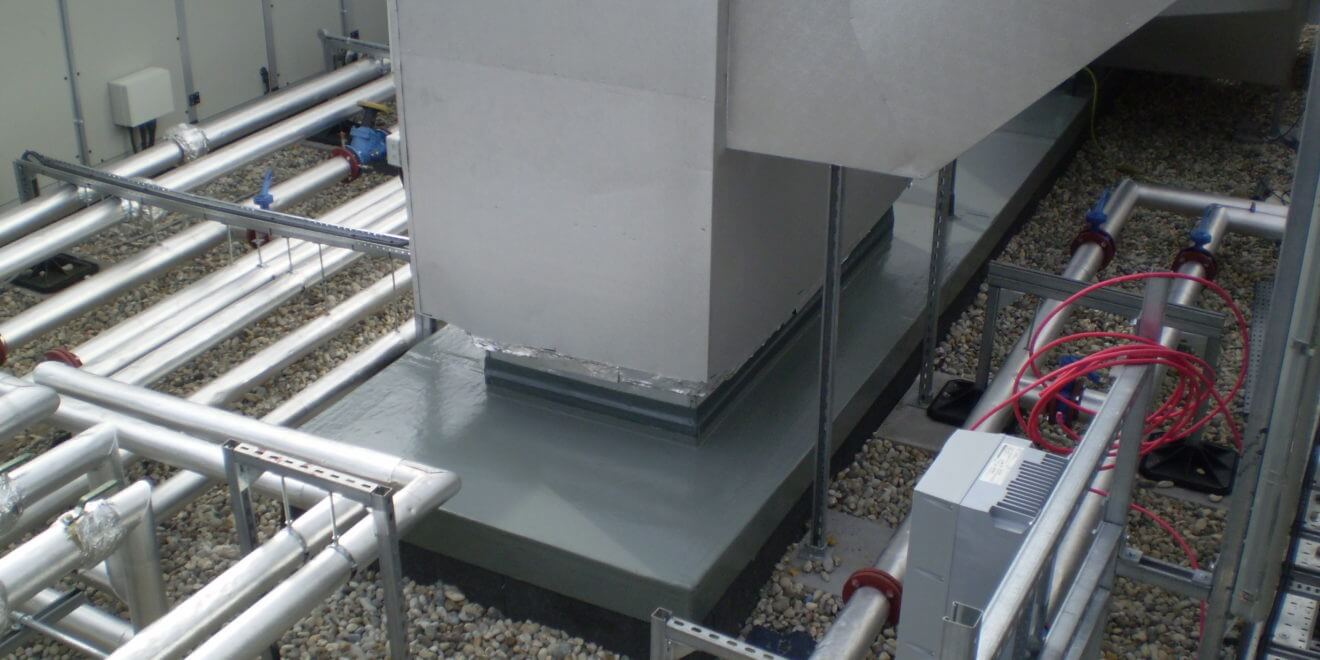
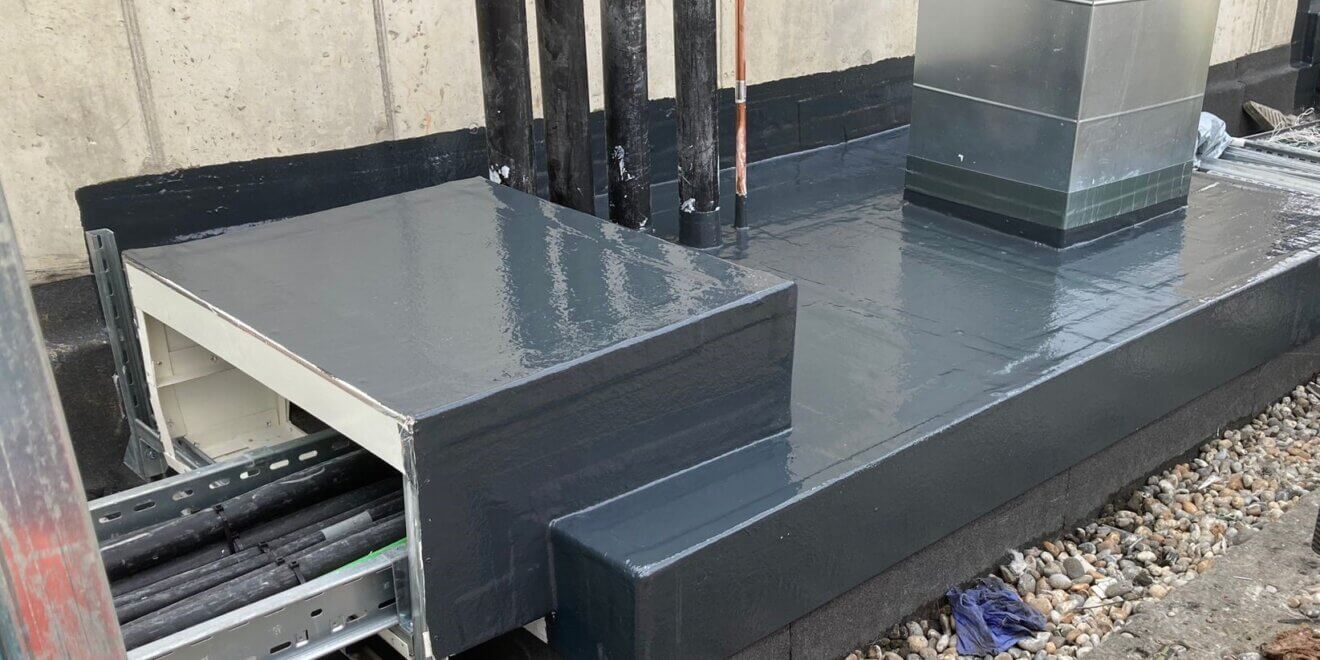
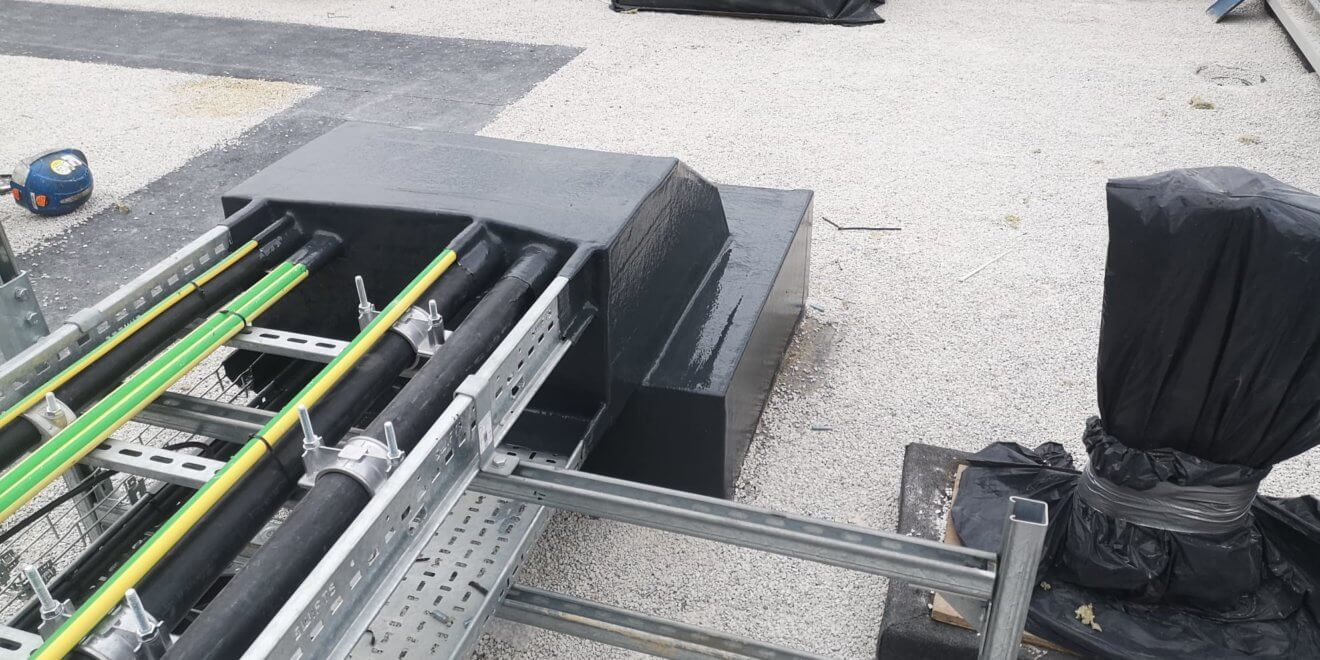
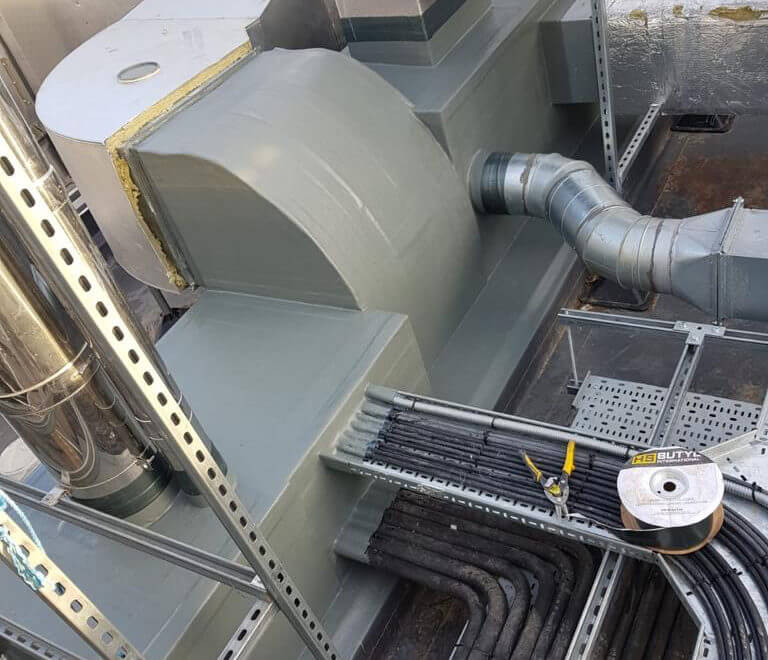
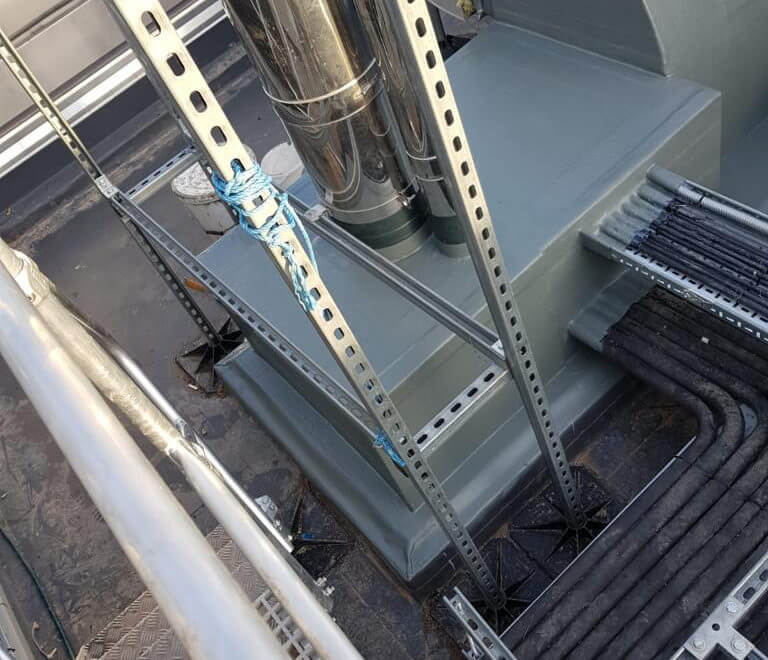
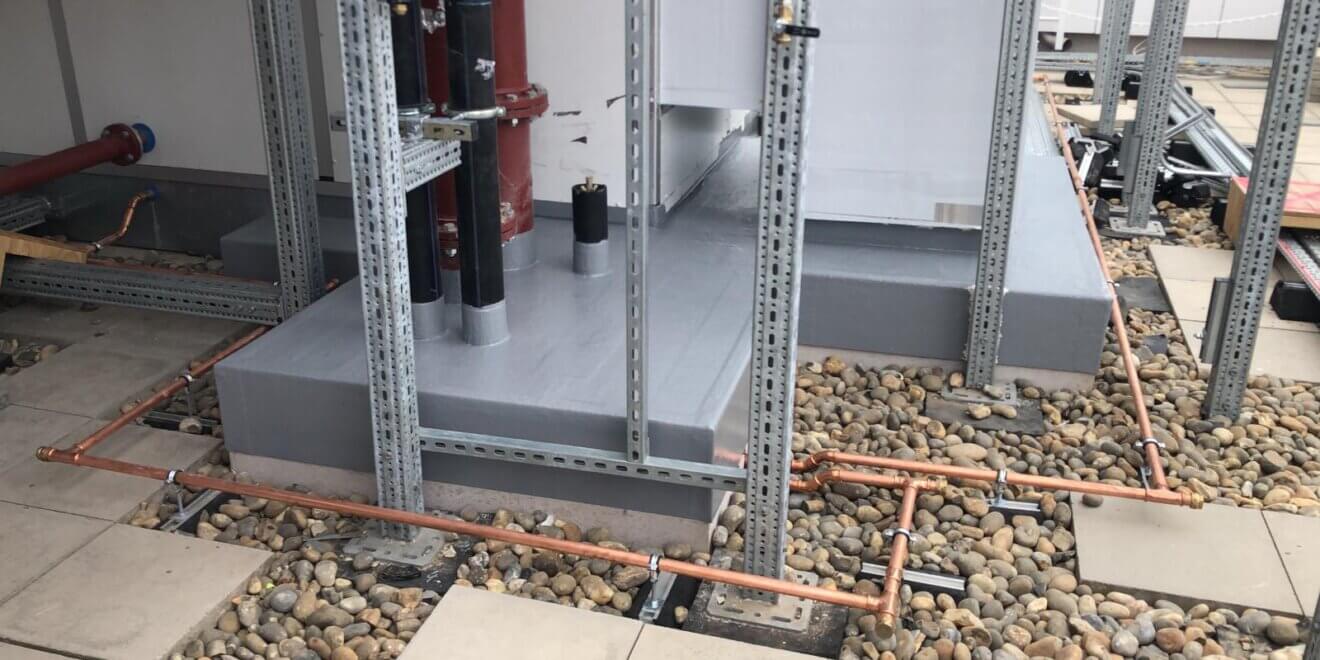
Complex service riser weatherproofed in London
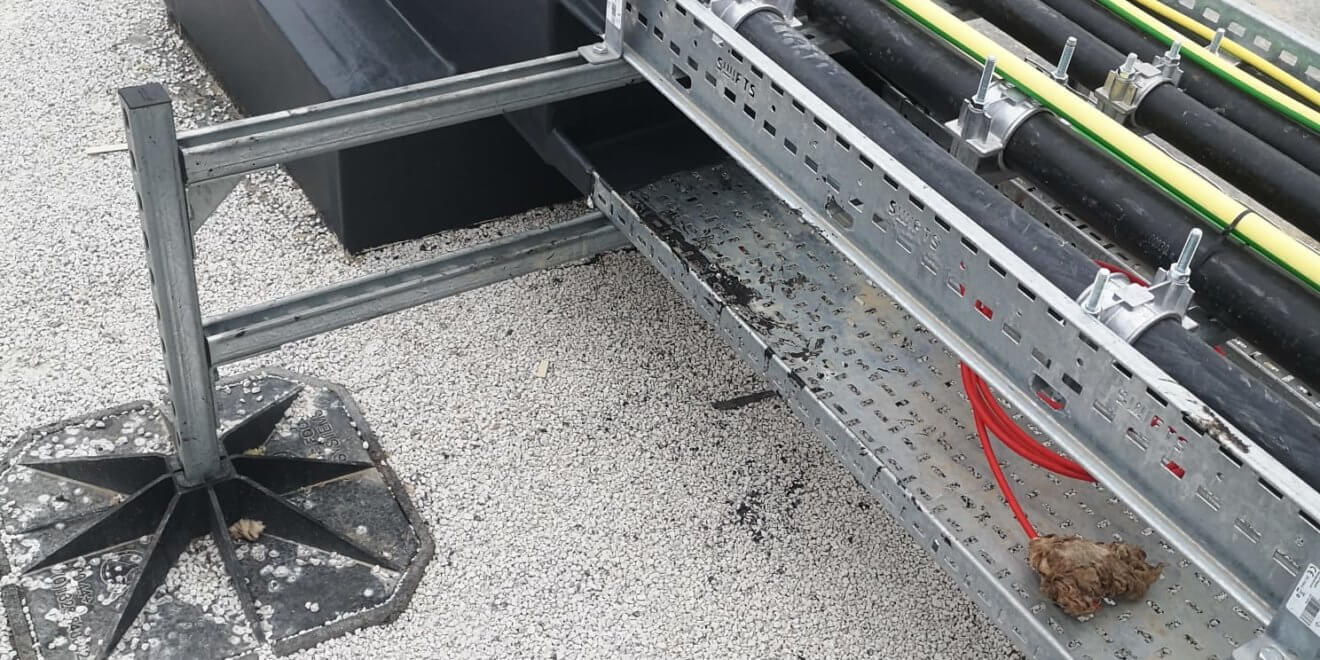
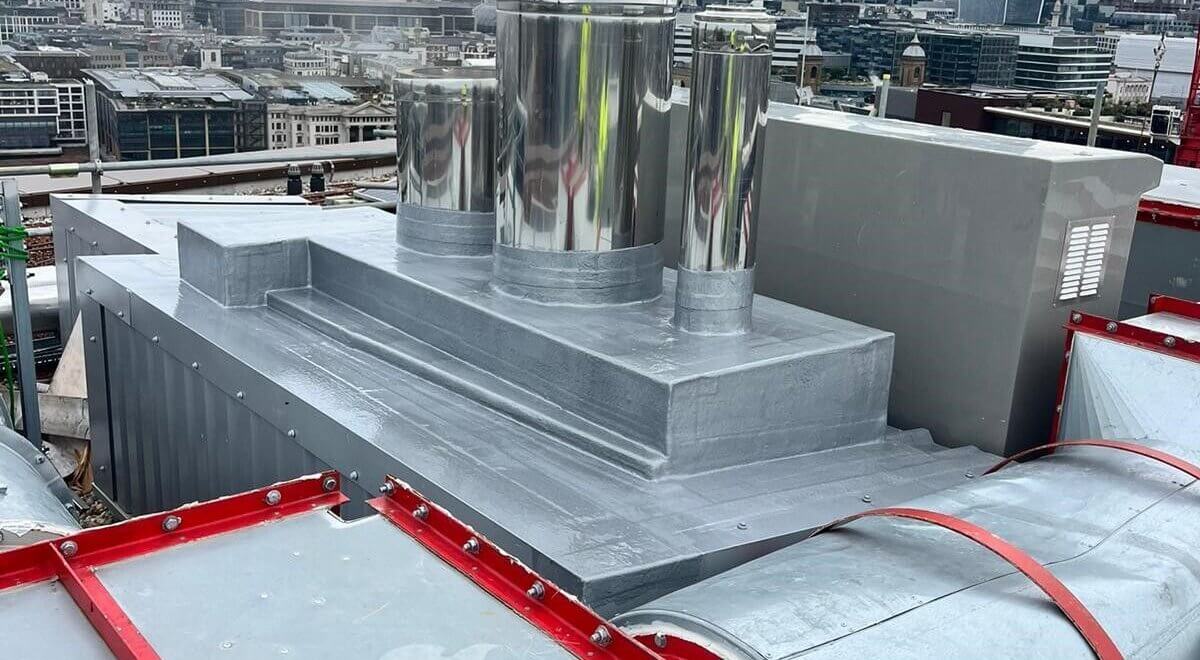
installed weatherproof system which connects to service riser


How does the Jones Weatherproofing system work?

Question: How does the Jones Weatherproofing system work?
Answer: Jones Weatherproofing uses a cold-applied liquid to create a durable, continuous and weather-tight seal around service risers.
In contrast to dog-kennel-style weatherproofing, which uses rigid enclosures around the roof penetration, the Jones Weatherproofing method allows services to run vertically. It also uses less roof space, simplifies maintenance access, can more easily adapt to changes in roof layout or service requirements and can be colour matched to specific project requirements.

When should weatherproofing service risers be considered during a project?

Question: When should weatherproofing service risers be considered during a project?
Answer: As early as possible. For best results, the weatherproofing of service risers and other building penetrations should be planned from the early design stages.

In many cases, weatherproofing isn’t considered until a project is nearing completion. However, this can lead to poor detailing and an increased risk of water ingress.

Leaving weatherproofing to the end of a project can also make access more difficult. Penetrations may be under other building elements or otherwise inaccessible and some elements may need to be removed to gain access, causing delays and additional costs.
Early planning can help determine the best layout for service riser openings; ensure service risers are accessible when the weatherproofing team arrives, reduce on-site disruption and limit the risk of water ingress.

Where can I find out more about service riser weatherproofing?

For more information about service riser weatherproofing, including specification advice and installation considerations, contact the Jones Weatherproofing team. We can answer technical queries, advise on project programming and arrange site visits to determine the best weatherproofing strategy for your project.
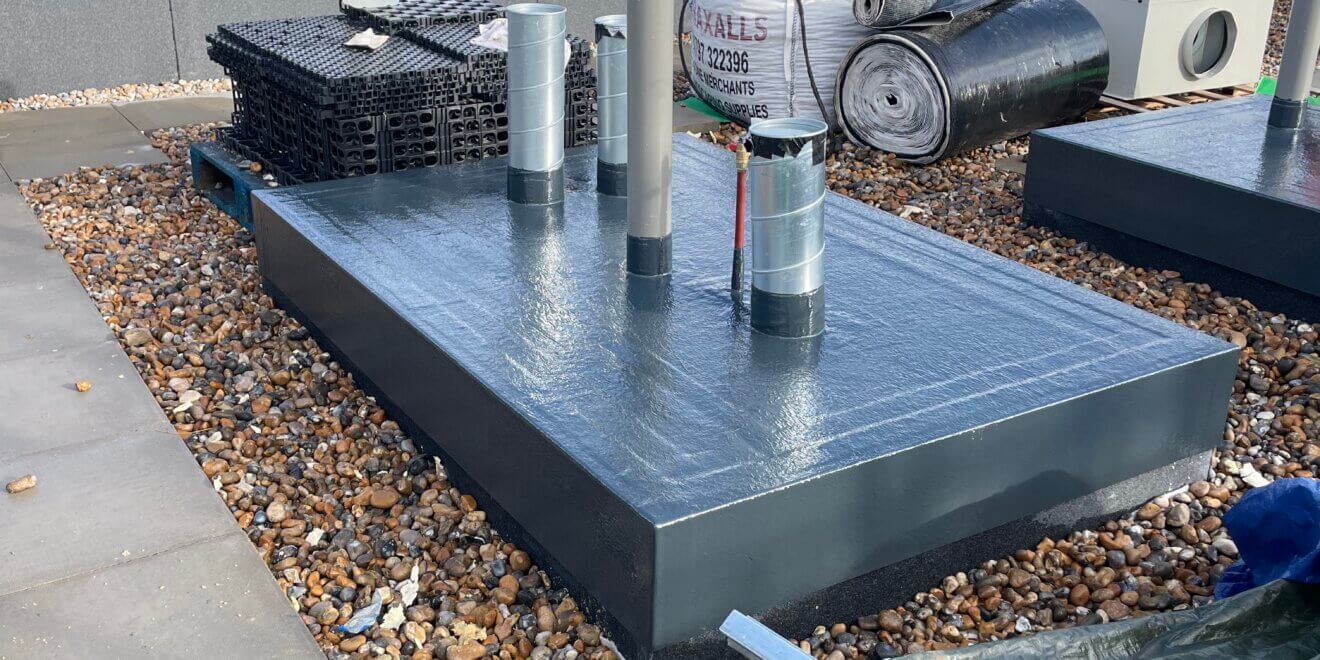
Dispelling myths about service riser weatherproofing

Share page here

As the mechanical and electrical loads of buildings have increased – particularly in data centres – the specification and installation of service riser penetrations has become even more complex.

While many advancements have been made in building design with regards weatherproofing, moisture management and safety, several myths persist about weatherproofing best practices and methods for achieving a weathertight finish around service riser penetrations. For example, there’s the ongoing reliance on “dog-kennel” or “dogbox” style enclosures and the belief that they are the only weatherproofing option for service risers.

Jones Weatherproofing has extensive experience in designing and installing modern weatherproofing systems that offer benefits over traditional dog-kennel detailing – such as reduced space requirements, a more straightforward installation and increased design flexibility. In this blog, we’re going to address some of the outdated assumptions and myths about weatherproofing service risers.

Myth 1: Services must come through horizontally, so dog boxes are the only reliable option

For many years, a common approach to weatherproofing service risers was to place a dog-kennel-style enclosure around the roof penetration, then have the services make a 90-degree bend and exit horizontally through the side.

While this method can create a reliable seal, it also has drawbacks. For example, services don’t just go in a straight line and may need to bend around other fixings, the enclosures can take up a lot of space, and the clustered layout of cabling, pipework and conduits can make future access and maintenance more difficult.

Modern weatherproofing techniques and materials mean that dog kennels and horizontal services are no longer the only option.
With the Jones Weatherproofing system, service risers can be effectively weatherproofed in vertical or horizontal configurations. This simplifies detailing, streamlines installation sequencing and saves space on the roof. It also offers a more flexible approach and can more easily accommodate last-minute changes on site.

Myth 2: Dog boxes are “best practice” for weatherproofing service risers

Dog kennel enclosures are robust, familiar and have been used for decades. It’s understandable that they are often considered best practice by default.

However, there is no single best practice approach, and familiarity should not be the reason for specification.

Dog boxes take up a large amount of roof space, which can affect the layout and maintenance access. Being fixed structures, they also don’t offer flexibility if services need to change, move or be increased on site.

Jamie Sporcic, senior sales manager at Jones Weatherproofing, explains that specifying a dog-kennel type system isn’t wrong, but it’s important to remember that there are other options. “For example, the weatherproofing methods offered by Jones Weatherproofing can achieve the same level of weather-tightness while also offering adaptability and reduced space requirements,” he says.

“Our system uses a cold-applied liquid solution that is compatible with any cladding or roof type, including GRP. It creates a joint-free weatherproof layer, saves space, adapts easily to layout changes or variations in service quantity and is backed by a 25-year warranty,” he adds.

Complex service riser weatherproofed in London


Myth 3: A large weatherproofing enclosure provides better protection

Dog-kennel-style enclosures are typically provided in standard sizes, which can lead to over specification. The thinking is that a too-big box is better than a too-small one, as it leaves space for additional services or future layout changes.

The problem is that large enclosures take up valuable roof space. They can increase wind load, restrict access routes and make future maintenance more complicated. Economically oversized specifications can also be money wasted if the box isn’t utilised to its maximum.

The Jones Weatherproofing method achieves effective weatherproofing without requiring bulky housings. Jamie explains that because the weatherproofing is applied directly around the services, they can be more evenly spaced, rather than bunched together. “This saves space, improves maintenance accessibility and makes it easier to add or adjust services during construction or later in the building’s life,” he says.

Myth 4: Weatherproofing service risers is something to think about at the end of a project

Service riser penetrations are a common failure point in roof systems. Late-stage planning and poor detailing are common culprits that can lead to water ingress, complicated maintenance and invalidated warranties.

Leaving weatherproofing decisions until the end of the programme often results in defaulting to dog-kennel enclosures, simply because they are familiar. In the late stages of a project, there may not be time to consider alternatives – and potentially more effective – options, such as the weatherproofing methods provided by Jones Weatherproofing.

Another problem with leaving the weatherproofing of service risers to the end of a project is access.

Weatherproofing is often treated like finishing work, and teams sometimes assume that it can be addressed after the services are installed – but this can lead to difficulties.

“If you wait until the end of a project to think about weatherproofing, it may become more challenging to access the penetration – particularly if other building elements have been layered above it. There may also be difficulty in accessing the penetration because other trades are also working in the same space,” Jamie warns.

He recommends planning the weatherproofing strategy as early as possible, as this can help to:

  • Determine the size and layout of service riser openings, avoiding the need to re-work them later.
  • Ensure that the penetrations are accessible when the weatherproofing team arrives.
  • Reduce disruption caused by removing or rerouting existing installations.
  • Avoid last-minute delays near the end of the project when the site is busy and schedules are tight.
  • Prevent late-stage delays when space and time are limited
  • Maintain a consistent standard of weatherproofing detailing and quality.
  • Allow time to consider various weatherproofing methods, including Jones Weatherproofing’s cold-applied liquid weatherproofing.

Vertical service penetrations from Jones Weatherproofing

Dog-kennel detailing has its place, and the team at Jones weatherproofing has extensive experience in installing and weatherproofing these types of products, but it’s not the only option for weatherproofing service risers or necessarily the most effective. The Jones Weatherproofing method accommodates vertical service risers with ease, offering on-site flexibility, saving space and providing dependable performance – all at a comparable cost.

Get in touch to find out how we can support the specification of weatherproofing for any upcoming projects.

Nicholson Roofbox® vs Jones Weatherproofing’s solution

Share page here

The Nicholson Roofbox® is a weatherproofing solution for building services, and an alternative to Jones Weatherproofing’s own weatherproofing system for service risers. The two approaches to weatherproofing building services are very different. The Nicholson Roofbox® showcases an off-the-shelf solution, while Jones Weatherproofing provides a bespoke approach to preventing water ingress.

As an off-the-shelf product, the Nicholson Roofbox® undoubtedly represents a convenient solution. However, that convenience must be balanced against whether it is the right solution for an individual project. Does the Roofbox® align with the building’s architectural vision? And is it better for the project overall to engage a weatherproofing specialist earlier in the design process

What is the Nicholson Roofbox®?

The Nicholson Roofbox® is a factory-made cabinet, available in different sizes and specifications to accommodate service penetrations. The various models of Roofbox® can accommodate multiple pipework and duct runs.

Instead of weatherproofing multiple service penetrations, only the Roofbox® itself needs weatherproofing. Once installed, it allows access for running and inspecting the services within, making for a convenient solution that carries little risk of water ingress.

What is Jones Weatherproofing’s weatherproofing system?

At Jones Weatherproofing, we create safe and reliable covers and seals of any shape or size, including clusters of multiple services. We insulate and weather service risers at curb level, directly to the services. Our solution is seamless, doesn’t restrict the direction of the services, and removes the requirement for ‘dog kennel’ style detailing.

Standard weatherproofing details are available on our website, which can be employed at any stage of a project to help achieve the right level of integration between building envelope and services. And we are often called on in an emergency, to address a problem that has arisen on site.

We can provide in-situ weathering for service risers in existing buildings. However, an even better way is for us to be involved from the early stages of projects. We work with clients to develop solutions for new build projects and can provide a vital connection between different members of the project team.

Complex service riser weatherproofed in London
service riser installed at sky studios elstree
Service-Risers weathering system
Service-Risers installed

What disadvantages are there with the Nicholson Roofbox®?

Where a system like Jones Weatherproofing’s looks to minimise the impact of service penetrations on the performance of the building envelope, the same may not necessarily be said of the Roofbox®.

Roof cabinets, like the Roofbox®, are marketed on the basis that the building services design is not usually known in the early stages of a project. The ability to accommodate more services than might be anticipated is therefore promoted as an advantage.

However, the larger the cabinet, the larger the penetration through the building envelope, creating a significant thermal bridge. Cabinets are insulated, but compared to modern roof U-values they are still a comparative weak point in the thermal envelope.

For building envelope efficiency, thermal bridges should be kept to a minimum rather than being made bigger ‘just in case’. But if you don’t make a roof cabinet bigger ‘just in case’ then you are left with a restrictive solution that doesn’t allow services to be added after installation. Jones Weatherproofing’s service has no restriction on services coming through the plant deck, and services can even be added after installation.

And as an off-the-shelf solution, the Roofbox® is not designed with the aesthetics of the specific project in mind. They are, of course, very well finished, but designed to be a universal solution to an issue that is unique on each building. They are purchased and installed to perform a function; not to align with the architect’s vision for the finished building.

This leads into another drawback that applies to roof cabinets generally, as Matthew Jones, Sales Director at Jones Weatherproofing explains: “Roof boxes and cabinets are often installed and weatherproofed crudely, so the finish is not as good as it could be. It also means the sealants and fixings are more prone to water ingress and associated issues, which is precisely what the roof box is supposed to guard against.”

Using a design and build service compared to a Nicholson Roofbox®

Improvising solutions on site, or relying on off-the-shelf solutions, can spoil the architectural vision of a building and have a negative impact on the building envelope performance. 

By contrast, Jones Weatherproofing can be part of the design team. Starting at the concept stage, our early involvement enables us to design and manufacture a high-performance weatherproofing system that works with the building.

Our cold-applied liquid GRP system can accommodate any type of roof system, can be applied to horizontal or vertical penetrations, and it is backed by a 25-year warranty to reduce risk and offer greater peace of mind.

Early involvement also means we can offer a dependable schedule of service and a high degree of installation flexibility that works with the sequencing of the project, helping to deliver on time and to budget. The principal contractor therefore enjoys the confidence of knowing their programme schedule is less likely to be disrupted.

Cost may also be something else worth considering. Whilst it could be assumed that purchasing an off-the-shelf solution would be cheaper than a more bespoke weatherproofing service, this may not be the case. Once you factor in the purchase of the product, the delivery and installation of the roof box, the overall cost is very comparable to a bespoke solution such as Jones Weatherproofing’s. Additionally, roof boxes usually come with a five-year warranty as standard whereas a Jones Weatherproofing solution is backed by a robust 25-year warranty which offers significant benefits and highlights the confidence a bespoke solution can afford a project.

To find out more about Jones Weatherproofing’s weathering system for service penetrations, contact us about how we can help on your next project.

Top 6 most common commercial weatherproofing mistakes

Share page here

Getting roof weatherproofing right is essential for any building – it protects the building envelope from damage caused by damp, rainwater ingress and wind, and it also protects the contents of the building and the building occupants. 

Over the years, we’ve been called out to repair hundreds of commercial roofs, and there are several weatherproofing mistakes we often see – many of which could have been easily avoided with careful planning, expert knowledge, and a skilled hand. 

Here are the six most common commercial weatherproofing mistakes we’ve seen, along with advice on how to prevent problems, mitigate damage and ensure proper repairs are carried out.

1. Neglecting maintenance

The amount of maintenance required for a commercial roof will depend on how the roof is constructed and what kind of weatherproofing is used. 

Many commercial roofs are flat roofs covered with bitumen, EPDM, metal, or thermoplastics, and these require regular maintenance and inspections to check for buckling, cracking, pooling, shrinking, damage, or deterioration. Any issues will need to be addressed quickly, as it doesn’t take long for a small problem to grow into a much larger one.

However, GRP (glass reinforced plastic) roofs, also known as fibreglass roofs, require almost no maintenance. Regular cleaning is all they need to retain their appearance and durability. GRP roofs have an expected lifespan of at least 25 years, and many last much longer than that. Of course, no roofing system is entirely problem-free, so even GRP roofs should be checked regularly to ensure they’re in good condition.

2. Not investigating underlying problems

When you notice a crack in the roof covering, discover a leak or spot a bit of pooling water on a flat roof, your first instinct may be to quickly patch up the problem and assume it’s taken care of. 

However, many roof weatherproofing issues are symptoms of underlying problems. For example, pooling water could indicate a poorly designed roof, weak or damaged roof structure or, in the case of roofs covered with a hot bituminous system, improper mopping that created voids in the membrane. 

If these underlying issues aren’t recognised – usually with the help of a commercial roofing expert – and properly dealt with, the problem is likely to return and increase in severity.

3. Blocked drainage or inadequate drainage

Standing water is a significant problem for commercial flat roofs for several reasons. For one thing, it adds weight, which could cause sagging and deterioration of the roof surface. For another, standing water is more likely to find its way through imperfections in the roof surface. It also encourages the growth of plants and moss. 

Keeping drains, gutters, and downpipes clear is part of good roof maintenance and will help ensure water leaves the rooftop quickly and efficiently. However, other drainage problems, such as a poorly designed roof or not enough drainage, will require the knowledge and skills of an expert roofing contractor to put things right.

4. Poorly constructed roof penetrations

Commercial buildings are likely to have a variety of roof penetrations, ranging from rooflights, access hatches and lift shafts to openings for HVAC equipment, chimneys, manufacturing plant and other machinery. If these penetrations aren’t carefully planned, constructed, and weatherproofed, there will likely be problems with leaks and drainage.

Ideally, roof penetrations should be considered early in the building design process. Working with a commercial roof expert will help to ensure that the penetration is constructed and weatherproofed adequately. 

However, roof penetrations are often installed after roof construction is complete – sometimes years later when the building is undergoing a change of use or refurbishment. In these cases, a roof penetrations expert can provide advice and guidance on the best locations for penetrations, the types of support required and how to weatherproof the installation for long-term reliability. 

And if an existing roof penetration is suffering wind damage or rainwater ingress, an expert can provide advice and carry out remedial works to resolve the problem.

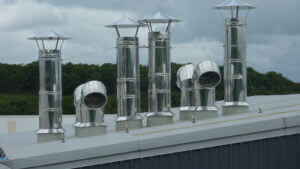
roof penetration installers tall pipes on top of a roof

5. Improper repairs

We often see cases where previous repairs were carried out using the wrong materials or installation methods. Sometimes this simply means that the repairs didn’t work or only lasted a short time. However, a bad repair job can cause more roof damage.

For example, it’s not unusual to see metal roofs that have been patched up with caulking and plastic roof cement. These materials are not fit for purpose and are likely to fail, especially in extreme weather conditions. On single-ply membrane roofs, roof cement can damage the roofing surface, as the solvents in the cement may dissolve plastics like PVC and EPDM.

The lesson here is that if commercial roof repairs are needed, it may be tempting to DIY it or find the cheapest rate around. But it usually pays to have a knowledgeable professional survey the damage and carry out repairs that will remain structurally sound and weathertight for years to come.

6. Not enlisting the help of a commercial roof weatherproofing expert

As we’ve already mentioned, calling in an expert with specific knowledge of commercial roof weatherproofing is the best course of action for building, repairing, or renovating a commercial roof.

Jones Weatherproofing has extensive experience in commercial roof weatherproofing, and we have worked on a wide range of projects, from shopping centres, schools and factories to data centres, airports, and sports stadia. Our cold-applied liquid fibreglass roofs provide a robust, reliable, and weathertight surface, and the system also works with all kinds of roof penetrations to provide a weatherproof seal.

We recommend getting in touch from the very earliest stages of a project. That way, we can provide advice and liaise with other teams to ensure the best results using the most straightforward methods. However, our flexible system, combined with our ability to design and build bespoke GRP components, enables us to successfully deliver reliable weatherproofing, backed by our 25-year guarantee, no matter how far along the project may be.

Get in touch to find out more about commercial roof weatherproofing, or discuss your next project with a weatherproofing expert, you can also call on 01922 712111.

How do service risers help achieve improved U-values?

Share page here

When carrying out work on a building’s fabric, the structure’s U-value is a critical consideration. This is especially true when dealing with building and roof penetrations since the holes created will need to be properly constructed and sealed to keep the U-values as low as possible.

Here at Jones Weatherproofing, we understand the importance of U-values, and that’s why we’ve developed our unique GRP service riser solutions for commercial buildings. These have been designed to provide a thermally efficient seal around roof penetrations, ensuring that the thermal efficiency of the building fabric is maintained.

Service risers and U-values

There are many different ways to measure a building’s environmental performance, and the main focus is generally on carbon and energy usage. The amount of heat that leaks from a structure plays a big part in how easy it is to maintain the internal temperature – and that’s where U-values come into the equation.

Also known as thermal transmittance, the U-value is calculated by determining the rate of transfer of heat through a structure and dividing it by the difference in temperature across the structure. Individual materials have U-values, but it’s the overall U-value of a building that ultimately matters. This means that all the materials used must be considered, as well as workmanship and the standard of installation.

Design can also play a part in a building’s U-values. For example, when finding a solution for service risers in a building, common ‘dog kennel’ or cladded ‘shed’ systems can have a detrimental impact on thermal transmittance. The service risers from Jones Weatherproofing, however, are designed to protect and seal in important systems – such as air conditioning equipment, electrical systems, factory plant and other building services – while also preventing unwanted heat loss from the building.

Service risers from Jones Weatherproofing – the better option

Here at Jones Weatherproofing, our fibreglass roof penetration solutions and service risers have been developed to ensure optimal U-values. They are a particularly good option for concrete insulated flat roofs on commercial buildings, but can also be used with other roof constructions.

In addition, our installation teams are experts at creating finished results that are weatherproof and effectively insulated, without gaps or cold bridges that could negatively affect a building’s U-values.

As well as the improved U-values of Jones Weatherproofing service risers, our solutions also have a lower profile than other options. This is ideal for building aesthetics, as the riser is less noticeable once installed. It’s also beneficial in locations like London where space and planning permission can be an issue. Other benefits include a quicker installation time, longer lifespan and a more cost-effective effective solution.

To find out more about the benefits of GRP service risers, and to discuss your requirements with the experts at Jones Weatherproofing, please contact us today.